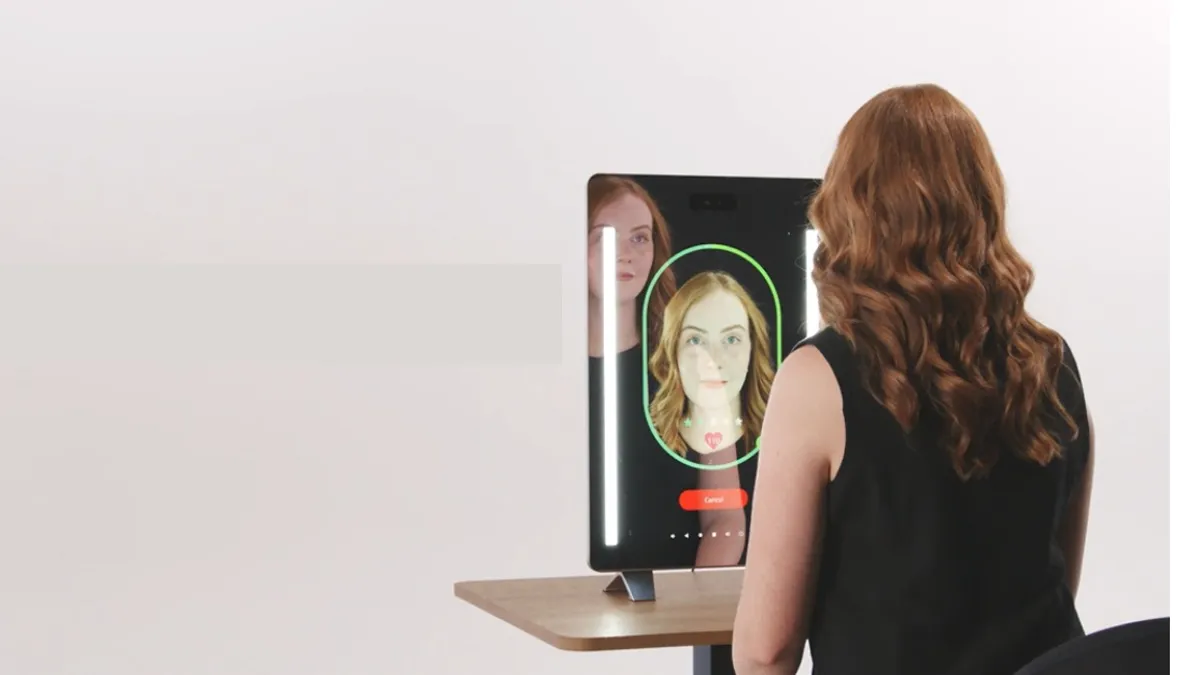
At CES 2026, the annual Consumer Electronics Show held every January in Las Vegas, Canadian startup NuraLogix unveiled something that stopped conference attendees mid-stride: a mirror that scans your health.
Not your reflection. Your health.
Stand in front of the Longevity Mirror for 30 seconds, and a camera reads subtle changes in blood flow beneath the skin of your face. This is a technique called Transdermal Optical Imaging which captures subtle changes in light reflected from facial blood flow and uses machine-learning models to infer physiological signals. Researchers have shown that facial imaging can extract cardiovascular signals from changes in hemoglobin concentration beneath the skin, essentially turning a camera into a contactless physiological sensor. AI then interprets those signals to generate a report on more than 100 wellness indicators: cardiovascular markers, metabolic health, stress levels, and estimates of how well you’re aging relative to your chronological age. No wearable, no blood draw, no waiting room.
Everyday decisions around sleep, stress, and cardiovascular and metabolic health shape how well we age. The mirror’s job, according to NuraLogix, is to make the invisible visible
Aging Is No Longer a Black Box
For most of medical history, biological aging was something that happened to you, a mystery unfolding in real time, legible only in retrospect through the accumulation of symptoms, diagnoses, and decline. We could measure how old you were in years. We could not measure how old your cells were.
That is increasingly changing.
AI has become a powerful instrument in aging science, enabling the identification of biological age biomarkers that can be meaningfully different from chronological age. Epigenetic clocks, which use DNA methylation patterns to estimate biological aging, have been dramatically refined by machine learning. Researchers have used these tools to show that biological age can be decades different from chronological age, and that lifestyle interventions can actually shift the biological clock not just slow it but meaningfully reverse some markers of cellular aging.
In the past decade, advances in machine learning and molecular biology have given scientists tools to estimate biological age, a measure of how quickly your body appears to be aging at the cellular level. One of the most influential breakthroughs was the development of epigenetic clocks, pioneered by researchers including Steve Horvath. These models analyze patterns of DNA methylation chemical modifications to DNA that regulate gene expression and change predictably with age.
Machine learning has dramatically improved the precision of these clocks. Research shows that biological age can diverge significantly from chronological age, and that lifestyle factors can influence the trajectory. A recent review proposed a comprehensive digital health framework for longevity that integrates AI with microbiome data, wearable biosensors, and inflammation markers. Published evidence from multiple randomized controlled trials cited in that review found that Mediterranean dietary interventions reduced a key inflammatory marker (hs-CRP) by 18 to 32 percent, increased microbiome diversity by 6 to 28 percent, and improved metabolic markers, all of which are inputs that AI platforms can now track and adapt recommendations around in near real-time. Simultaneously, AI drug discovery is moving at a pace that would have been unimaginable five years ago.
As of early 2026, more than 173 AI-discovered compounds were in clinical development, with AI-designed molecules showing Phase I success rates of 80 to 90 percent compared to historically around 40 to 65 percent for conventionally discovered drugs. A significant portion of these programs are targeting the biology of aging itself.
We are, for the first time, developing the tools to not just describe biological aging but to actively intervene in it.
The Missing Decision Layer: Where the Science Meets Real Life
Here is the part that nobody in the longevity tech industry talks about enough.
The science of biological aging is advancing rapidly. The technology to monitor, analyze, and act on aging-related health signals is proliferating. But the human decision-making required to navigate all of this is not keeping pace.
How will you make decisions about what to track, what to act on, what to share with physicians, and how to emotionally metabolize information about your own biological trajectory? All these challenging questions are important. And they are not being discussed enough, if at all.
And that’s a problem.
A recent review of AI innovations in gerontological care noted that while AI holds , transformative potential for supporting older adults’ health and well-being, disparities in digital access, digital literacy, and algorithmic bias risk exacerbating existing inequities. An AI longevity platform that works beautifully for a tech-savvy 50-year-old with high digital literacy and a comprehensive care team does not automatically work for a 78-year-old in a rural community managing multiple chronic conditions with a single overextended primary care physician.
And there is a deeper psychological dimension here that I think about a great deal. From a neuroscience perspective, health information is never purely informational. Being told your biological age is ten years older than your chronological age is not a neutral data point. It is an emotionally loaded piece of information that lands inside a person’s existing beliefs about themselves, their family history, their sense of control, and their relationship with mortality. The neuroscience of health behavior shows us clearly that information alone does not reliably change behavior, particularly when that information is threatening. Defensive processing, denial, and avoidance are all well-documented responses to health risk information, especially when people don’t have a clear sense of what to do about what they’ve learned.
Technology can tell you what. It cannot tell you how to live with the answer.
Questions Worth Asking Before You Buy into Longevity Tech
The science of healthy aging is evolving quickly. I believe that this is an exciting frontier in medicine and public health. And I also believe that the speed at which these tools are reaching consumers outpaces the clinical, psychological and regulatory infrastructure needed to deploy them responsibly.
Before you invest in a longevity mirror, a biological age clock, or an AI-powered aging intervention, here is what I’d want you to think through:
What will I do with an answer I don’t expect?
This is the question most people skip. Longevity technologies work best as part of a care relationship, with a physician or specialist who can help you interpret and contextualize the results, and who can support you in taking meaningful action. Receiving a biological age estimate in isolation, with no clinical follow-up, is not empowerment. It’s data anxiety waiting to happen.
Does this tool account for the full picture of my life?
The best evidence for healthy aging consistently points to lifestyle factors including sleep, nutrition, movement, stress management, and social connection as the primary levers. An AI platform that helps you optimize those fundamentals is grounded in the science. One that promises to slow aging through supplements or proprietary compounds without strong clinical evidence is not. The gap between what’s being marketed and what’s been rigorously validated is still wide.
Am I approaching this with curiosity or fear?
This question is worth sitting with honestly. The people who tend to benefit most from health monitoring tools are those who approach the data with curiosity and a growth mindset, not those who are driven by health anxiety or a fear of mortality. If you find yourself obsessively checking metrics or catastrophizing over every fluctuation, that is data too. This is information about your psychological relationship with health technology, not your biological age, and it is worth paying attention.
How does this fit into rather than replace my existing care?
The future of aging well is not a mirror, a ring, or an algorithm. It is a thoughtful integration of these powerful new tools with skilled human care, meaningful relationships, and the kind of personal values-based decision-making that no AI can replicate.
Aging Well in the Age of AI
When I described the Longevity Mirror to an older relative, he paused for a moment and then said, with his characteristic deadpan humor: “I already know what it would tell me. I need to walk more and sleep better. You don’t need a $500 mirror for that.”
He is, of course, right. And also, slightly missing the point.
For people who genuinely want to understand their biological aging, who are motivated, who have access to appropriate clinical support, who can tolerate and act on the information, these tools represent a real opportunity to make more proactive, informed decisions about one of the most consequential processes in human biology.
The technology is not the barrier. The decision-making capacity to use it wisely is.
That’s what precision medicine has always promised: not generic advice for the average person, but deeply personalized guidance grounded in your own biology. We are getting closer. But closer isn’t there yet.
Age wisely. And ask good questions along the way.
What does “aging well” mean to you? Are you using any longevity or aging-related health tools? I’d love to hear your perspective in the comments.
Photo courtesy of NuraLogix